- 43. Daria Kiseleva, Museum of Virtual Nature, May 2019
- 42. Dongyoung Lee and Michiel Hilbrink, Intermittent, as if a space of time could not be occupied by two bodies, Jun 2018
- 41. PA-AP, Archipelago, Mar 2018
- 40. Liesbeth Doornbosch, No One Home Series, Baustelle, Jan 2018
- 39. Charlott Markus, Solitaire, Oct 2017
- 38. Constant Dullaart, Adversarial Protean, May 2017
- 37. Harris Blondman & Louisa Zahareas, Remember/Imagine, Oct 2016
- 36. Sibylle Eimermacher, Fundort (In the human eye, the pupil is the aperture), Jul 2016
- 35. Antoinette Nausikaä, Something is looking back at me..., Mar 2016
- 34. Maartje Fliervoet, Mischung machen, Feb 2016
- 33. Sharon Houkema, Playing the Bucky Card, Nov 2015
- 32+. Jeroen Glas, 0/I, Oct 2015
- 32. Jeroen Glas, 0/I, Oct 2015
- 31. NOMAN, Something will Happen, Aug 2015
- 30. Navine G. Khan-Dossos, Komt Hier Aan Deze Gele Vlaktes, Jun 2015
- 29. Sascha van Riel, Untitled, May 2015
- 28. Lado Darakhvelidze & Onno Dirker, Memory Builders – Four stories from the Caucasus, Feb 2015
- 27. Sunette Viljoen, Two-striped semi-ornate shovel snout, Jan 2015
- 26. Marcel Reijerman, The Draftsman giving himself a hard time, Nov 2014
- 25B. Susan van Hengstum, Cadre, Sep 2014
- 25A. Susan van Hengstum, Cadre, Sep 2014
- 24. Sjoerd Tim, Fountains of Grace, Jul 2014
- 23. Frank Koolen, FIN, May 2014
- 22. Paul Bailey, Looking for/through/with/amongst/beyond/around content, Oct 2013
- 21. Ellen Boersma & Rob Sweere, Skin, Oct 2013
- 20+. Mirjam Kuitenbrouwer, Revolving Voyeurism, Apr 2013
- 20. Mirjam Kuitenbrouwer, Revolving Voyeurism, Apr 2013
- 19. Derk Thijs, Flowers of Winter, Feb 2013
- 18. Katja Mater, Site Specific Density Drawing 18/12/12 Arnhem, Jan 2013
- 17. Batia Suter, Lecture, Dec 2012
- 16. Coen Vernooij, Dissolving Spaces, Oct 2012
- 15. Rob Voerman, Aftermath, Sep 2012
- 14. Theo Konijnenburg, Untitled, Jun 2012
- 13. David Weber-Krebs, Apr 2012
- 12. Emmeline de Mooij & Lisa Vieten, The Atmospheric and other Soft Mental Areas, Mar 2012
- 11. Marika Asatiani, 11 Currents of Air, Jan 2012
- 10. Heidi Linck, In the Eye, Dec 2011
- 9. Albert Van Der Weide, Outside/In, Oct 2011
- 8A. Marten Hendriks, Levels of Measurement, Jun 2011
- 8. Marten Hendriks, Levels of Measurement, Jun 2011
- 7+. Marcel Kronenburg, Unrepeatable Carpets, Dec 2010
- 7. Marcel Kronenburg, Unrepeatable Carpets, Dec 2010
- 6. Berndnaut Smilde, Nimbus, Oct 2010
- 5. Petra Noordkamp, Sep 2010
- 4. Sylvie Huysman, May 2010
- 3. Ruth van Beek, Apr 2010
- 2. Oscar Lourens, Glikoneri, Jan 2010
- 1. Peggy Franck, Destination in the Clouds, Oct 2009
- ( ). SY-GD-19, Students edition (temporary, progressing), Jun 2019
 Essay
Essay Essay
Essay Essay
Essay Essay
Essay Essay
Essay Essay
Essay Essay
Essay Essay
Essay Essay
Essay Essay
Essay Essay
Essay Essay
Essay Essay
Essay Essay
Essay Essay
Essay Essay
Essay


Probe is a virtual exhibition space by art-initiative Suze May Sho. Artists from different disciplines are invited to explore their own practice and challenged to rethink their working methods.
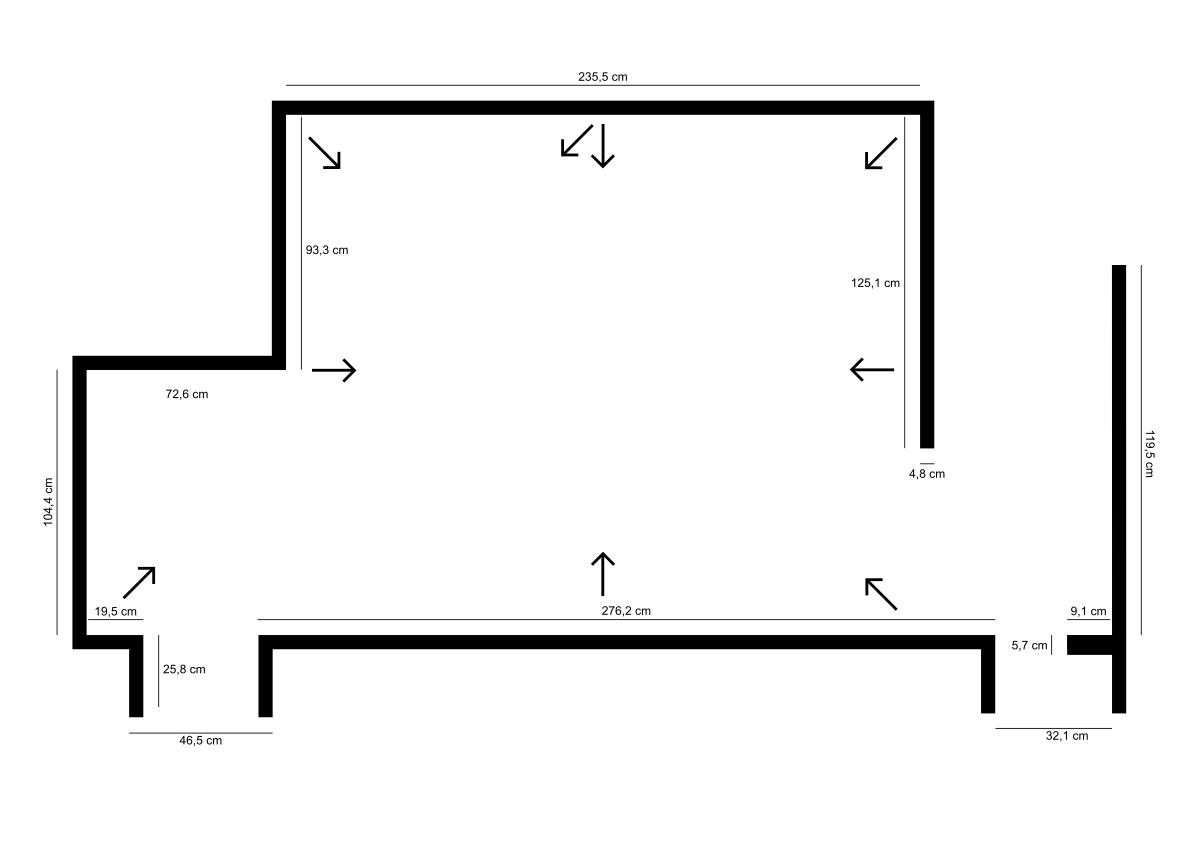
Probe has walls no higher than 1,10m and a surface of 6m2. It’s a test lab, an artistic skinner box; Its small and practical dimensions enables artists to create works that are unthinkable in real life. The architecture of the space is flexible and wholly subservient to the exhibition: walls can be extended, doors can be removed, a floor made of glass, mirrors or wood, even the lighting situation can be fully controlled.
Probe’s flexible dimensions proposes questions as to the nature of space, seeing for example, that Probe can be wholly absorbed by the installation it contains. Exterior or interior, architecture or sculpture become relative notions. Probe can also be used as a tool for exhibition making. The height, size and sequence of several works can be researched without ever having to drill a hole. Sketches can be used as dummies, scale warps achieved in seconds.
Even though it is a physical space, Probe is only accessible on the Internet. The registration of the exhibition is the exhibition.
Probe is no longer open for applications.
Probe is initiated by Suze May Sho who started the project in 2008. The programme stopped in 2019.
This website was designed and build in 2016 by Charlie Berendsen in close collaboration with Suze May Sho.
Probe was made possible with the support of the Provincie Gelderland (2010, 2014-2016), the Gemeente Arnhem (2014-2016), the Mondriaan Fonds (2015, 2017) and the Stimuleringsfonds Creatieve Industrie (2015).
Disclaimer
Copyright on all content lie with Probe and the individual authors. Probe encourages the use of its content for purposes that are non-commercial. In any such case, make sure you credit the author(s) and Probe. For print and online publication of any content from this website please contact us here.
Artists
Albert Van Der Weide
Antoinette Nausikaä
Batia Suter
Berndnaut Smilde
Charlott Markus
Ciprian Burete (PA-AP)
Coen Vernooij
Constant Dullaart
David Weber-Krebs
Derk Thijs
Daria Kiseleva
Dongyoung Lee and Michiel Hilbrink
Elien Ronse (PA-AP)
Ellen Boersma & Rob Sweere
Emmeline de Mooij & Lisa Vieten
Frank Koolen
Heidi Linck
Jeroen Glas
Jonathan Baumgartner (PA-AP)
Katja Mater
Lado Darakhvelidze & Onno Dirker
Liesbeth Doornbosch
Louisa Zahareas & Harris Blondman
Lucie Draai (PA-AP)
Maartje Fliervoet
Marcel Kronenburg
Marcel Reijerman
Marika Asatiani
Marten Hendriks
Maya Watanabe (PA-AP)
Mirjam Kuitenbrouwer
Navine G. Khan-Dossos
NOMAN
Olivia Abächerli (PA-AP)
Oscar Lourens
Paul Bailey
Peggy Franck
Petra Noordkamp
Rob Voerman
Ruth van Beek
Sascha van Riel
Sharon Houkema
Sibylle Eimermacher
Sjoerd Tim
Sunette Viljoen
Susan van Hengstum
Sylvie Huysman
Theo Konijnenburg
Zoe Scoglio (PA-AP)
Writers (Essay)
Dominic van den Boogerd
Daria Kiseleva
Ilse van Rijn
Julia Geerlings
Karen Archey
Loes van Beuningen
Louisa Zahareas & Harris Blondman
Marian Donner
Martijn in ’t Veld
Miek Zwamborn
Nanda Janssen
PA-AP
Ton Verstegen
Vincent van Velzen
Designers (Essay)
Bart de Baets
Carla Peer
Catalogtree
Charlie Berendsen
Connie Nijman
Corine van der Wal icw Cas de Rooij
Daria Kiseleva
Dongyoung Lee
Fred Cave
Hans Gremmen
Louisa Zahareas & Harris Blondman
PA-AP
Robert Milne & Maria Mitcheva
Sam de Groot
The project Probe was an exhibition concept by curators Suze may Sho that ran from 2009 and ended in 2019. The Probe productions took place in the studio of the collective in Arnhem (NL) – in close collaboration with the artists, designers and authors involved. Say hello if you want to know more about the history of the project, or if you wish to get in touch with former Suze May Sho members.
The word ‘Diorama’, which translates from the Ancient Greek as ‘to see through’, was first coined by the French artist Louis Daguerre, who in the 18th century started staging theatrical performances in which realistic scenes painted on translucent screens were illuminated from behind. The scenes eventually evolved to include 3-D objects, but it wasn’t until the late 19th century that dioramas as we think of them now were used for science education.
You are in the museum of virtual nature, populated by algorithms. It conserves their natural habitat behind the glass barrier, and like a diorama in a nature museum, it is meant to observe and study this environment. But unlike a classical diorama, that centres on the featured animal, it focuses on its environment, that becomes the main character, leaving the ‘animal’ invisible.
Dongyoung Lee and Michiel Hilbrink:
When, in our work, we focus on what it means to share, we don’t consider sharing a concrete object. Rather, our interest is pointed towards sharing intangibilities like, for example, ideas, histories, futures, cultures, experiences and spaces. We look at how they are shared between subjects, but also between subjects and objects.
The work we made for Probe started from the notion of a shared image of Pompeii. An image many people carry in their mind as they know at least a small thing about it. Considering the idea of a shared image, it suggests an overlapping understanding between two or more persons. Often, it is as if there is a consensus about the definite form of the image shared. The one of Pompeii, like all other shared images, has no stable form, but appears every time as a variation of a previous version. The shared image is a fluid entity acting as an ever changing memorization. There is, of course, no person alive who has seen the eruption of the volcano. Only the ruins, bodies and the documents are the facts we can follow, and these are staged and composed. While this is all clear to us, it is still easily possible to talk about Pompeii, as we somehow, unconsciously, trust in a general image we have from it.
For Probe we developed sculptural works from thinking about this mechanism. We build columns made of different circular fragments of one single image (see Reference). It is an image of two superpositioned consecutive frames from Roberto Rossellini’s film Journey to Italy (1954). At the time it was shot, close to Pompeii, new excavations where executed and documented by Rossellini. He used the footage in the narrative, resulting fiction and documentary to blend. The image we used shows an exceptional moment in the film in which a married couple stands eye-in-eye with a just excavated couple from the grounds of Pompeii. Amidst these real excavations, nobody was aware a couple would appear from the ground.
Rossellini’s focus on the private conversations and frictions between the two protagonists can be taken into a wider perspective. They share a history, culture and life, but, as it turns out, this sharing is based on many preconceptions. When confronted with each other while on their short stay in Italy, they discover the image they have of their shared world turns out vague and very different from what they thought they knew. They are not only strangers within the foreign Roman culture and history, but as well within their own constellation as a husband and wife. Interestingly, even the actors, playing their roles without being allowed to prepare or read the script, were confused and troubled. All contradictions accumulate and melt together in a compelling moment at the end of the film in which they find themselves confronted with a dead couple being excavated in front of their eyes.
The film Journey to Italy deals on many levels with our interests and it appears indirectly in the work. We turned the story literally into material – as stacks of paper – rendering a situation both specific and fluid. The different camera points register the story in the space each from a different perspective, accumulating into a collection of overlapping fragments, yet not offering a comprehensible whole. This is enhanced by the fact that the columns block the space at large and effectively reverse the gaze towards the beholder.
PA-AP is made up of:
Maya Watanabe
Jonathan Baumgartner
Ciprian Burete
Elien Ronse
Zoe Scoglio
Olivia Abächerli
Lucie Draai
in collaboration with Suze May Sho, Annie Fletcher, Nick Aikens and Navine G. Khan-Dossos.
As part of the Van Abbemuseum group (Practicing Articulation/ Articulating Practice) situated within the Dutch Art Institute, Archipelago is an exercise in working towards making a show co-operatively. Inviting Suze May Sho as our guest tutors, they in turn invited us into Probe to make an edition in two days. The intention has been to experiment in a short and defined amount of time, how a process and an exhibition can collide and change form through individual and group gestures and decisions. Clay acts as the central axis, informing the show’s methodology and material concerns and possibilities. A series of rules are defined together to structure time and allow the exhibition to morph rather than just being a series of final images. The edition includes images of the beginning and end of the process but also a GIF of the play and change, developing from each other as two individuals enter at a time, and work upon the authored shapes presented to them.
Q&A with Charlott Markus
What did you want to create in Probe?
In the beginning of 2016 I arrived at Kastrup Airport in Copenhagen and I was on my way to take the train over the bridge to Sweden. In my hand I had Orwell’s 1984 that I was rereading at the time, finding it just as intriguing as when I discovered it in my late teens. It didn’t occur to me that someone would check my passport, not only once but twice, on this short normally 20-minute trip over the border. It was the first time in half a century that Sweden had re-introduced very strict border controls. With George Orwell in hand it felt even more eerie, uneasy and indescribably sad. The feeling of constantly seeing the emperor’s new clothes or huge elephants in rooms when watching politics, news, social media and events doesn’t shake this eeriness, it makes it worse. And the many conversations that I have had where things often get presented to me as black and white or as what ‘could have been’ and hearing people mirroring themselves in their own fears and stereotypes. It’s not only eerie, it is real and this is constantly on my mind.
When standing before the possibility of making an edition in Probe I realized I wanted to try to visualize a sort of poetic statement. Normally I work in a theater like fashion where I create an alternate space and in this space the margins between photography, installation and sculpture becomes intertwined and sometimes diffused. Solitaire is a work where one can choose to see the illusion or the vast poetry: a seemingly black and white space, yet full of colours, reaching for the stars while being reflected in dark waters. A reminder of how small and insignificant we all are and yet we all seem to strive towards being the one and only solitaire. Dressed as the emperor and being the only elephant in the room.
How different was it to work in the space of Probe compared to other exhibition spaces?
With the scale 1:4 it is definitely a small space, but on the other hand it is also not a miniature space with its 7m2. With my installation works I always want to create an experience, an experience that is only attainable when the audience has a direct relation to the work, a physical one. While the artist works in and observes its physical space, the viewer can only visit Probe virtually via a set of 9 photographic angles. This offers completely different possibilities than in a normal sized art space and I think it asks for a different approach to the process. Since the documentation of my installations doesn’t give the right impression or the same experience as when one spends time with the work in real life, working in Probe was an interesting challenge for me. Instead of being able to give a direct physical experience of the work I instead needed to communicate an atmosphere, or an emotion if you so like.
Another exciting aspect of working in Probe is that it provides the opportunity to try things out that would not be possible in a real sized public space. To make a Probe edition basically means to challenge your working method and to be able to unfold the impossible. For me it was an overall great experience.
What obstacles did you run into?
Not an obstacle but something that needed special consideration was the light source. To be able to control the light and to create the depth of a night sky I realized I had to extend the space of the Probe. The solution was to build an elevated custom-made roof construction on top of the Probe space and then dress it with a dark material from the inside.
It was also important to find a way to make the floor as reflective as possible. Painting the existing floor with high gloss would never be enough since it is an uneven floor full of traces and holes from earlier editions. Luckily, attaching another reflective and smooth material on top of the existing floor easily solved this problem. Unfortunately though this new material attracted every dust particle possible in its surrounding, and this didn’t become visible until we took the final photographs. This led to an incredible amount of postproduction, meditatively removing each and one of these suddenly very present particles.
While working in Probe, it is of course harder to see the work from a distance since one is physically too big for the space. This was not an obstacle as such, but while trying to shoot the final photographic angles it definitely gave me an incentive to finally start taking yoga classes as seriously as I do my work…
Q&A with Harris Blondman & Louisa Zahareas
What did you want to create in Probe?
The starting point for this project was our fascination with how machines see the world. Our most intimate technologies, such as screens—and soon virtual reality headsets—are making our experiences increasingly visual, and detached from the physicality of the world. And, we gladly outsource our gaze to these machines. Already, we’ve developed algorithms and deep neural networks that train computers how to see. But, how do they interpret our world? As humans, we perceive our physical world through our senses, and we are able to assign meaning to objects and images through our interaction with them. But, could the same thing be said for an artificial intelligence? How is our experience different when we live it through the prisms of machines? How would a speculative artificial consciousness perceive and experience things? How could we showcase a rising mechanical or digital consciousness? These were some of the questions that inspired the work Remember/Imagine, which consists of nine images and a visual essay.
For this work, we created an installation that reacts to the inherent qualities of the Probe setting, such as the fact that you can see what is inside the space only through nine camera views. The goal was to capture this installation in a series of fragmented views, never really giving away the whole picture, and in this way showing how the space itself might perceive it. The space is imagined as a perceptive tool, machine, or consciousness that is capable of experiencing the installation in a very specific way. Inspired by vanitas paintings, elements of a vanitas still life were translated into objects, which were then distorted with a computational algorithm. The resulting objects can be viewed correctly only through the point of view of a camera occupying a very specific position.
How different was it to work in the space of Probe compared to other exhibition spaces?
As Probe is a space which really exists only in images, we were interested in the fact that the spectator does not get to directly experience the artwork, but only the documentation, through a camera which is inherently limited in perceiving a 3D space in its entirety. When you think about it, most of the artworks presented by Probe are actually specifically made to be seen only in 2D pictures. Another interesting aspect for us is the time discrepancy between the physical and the virtual experience of the exhibition. In other words, an artwork in the space is most probably not even there anymore when you view the exhibition online, and this worked very well with the notion of a vanitas.
The space was crucial in designing the final output; it actually dictated the installation itself. More specifically, the space informed not only the scale but also the shape of the distorted objects, as well as the color of both the objects and the walls. Everything was designed and mathematically distorted based on how the specific camera that documents the exhibition “sees” the installation. For the visual essay, we wrote a theoretical piece about the evolution and variation of the biological visual sensory apparatus, which we then rewrote as a poetic monologue; as if the Probe space—or an artificial consciousness, or perhaps knowledge itself—is expressing its experiences and ideas about vision, or contemplating the installation. In this text, notions of sensory experience, memory and imagination blend together.
What obstacles did you run into?
Physically positioning the deformed objects in Probe, so that they matched the final viewpoint of the camera, was very demanding, as it required a degree of mathematical precision that was hard to achieve in such a small and dark space. However, it is very interesting to see how these computational 3D models—which were very precisely designed in a virtual environment—become slightly inaccurate when they are materialized as objects and positioned in an actual space. These slight inaccuracies, that are a by-product of physical production and setting up, ended up making the result more interesting and human, especially when shown as images, in a digital space.
Q&A with Sibylle Eimermacher
What did you want to create in Probe?
I wanted to investigate the relation between the displayed objects, the viewer, the space, and the objects among each other. In Probe you work with fixed camera angles that replace the eyes of the viewer. For me this possibility to direct the view so precisely seemed a very interesting point of departure. I also wanted to break with the static setup of usual exhibitions in order to emphasize the ungraspable aspects of my work and digital images in general.
How different was it to work in the space of Probe compared to other exhibition spaces?
Working in a space that will only be entered by the visitors online means that you can play differently with illusion. As the artist you can make viewers believe or doubt or maybe most important… become indifferent about what is real and what is not.
Further there is a very strong physical experience when working in this limited space. This sharpened my awareness for my position towards the space, the changing materiality and tactility of the floor and ceiling for example. But also towards the objects which I moved constantly.. because of their fragile character I had to be aware of their position all the time.
What obstacles did you run into?
I underestimated the complexity of the space. A smaller space offers more possibilities, almost like starting from a blank canvas. There is very little given situation where to relate to, everything is adjustable.
Another thing was the difficulty to step back, to create a distance from what I was doing, because from the start I already worked in this parallel manner: Physically but at the same time looking from a distance (through the camera eye). For me it was almost impossible to increase this distance in order to reflect, so I somehow felt haunted by the work during the whole process.
Q&A with Antoinette Nausikaä
What did you want to create in Probe?
For Probe I wanted to recreate a specific moment that I experienced in Greece at the foot of mount Olympus in 2014. This moment was about me observing a man sitting on a big rock looking at the sea.
At the same time behind me the big mount Olympus was looking out over us while also the sea was looking back at the mountain. It felt like all the elements including myself were observing one another and froze in time as if keeping each other in balance.
How different was it to work in the space of Probe compared to other exhibition spaces?
In my installations I always work with different media such as photography, drawings, sculptures and video. In making the installations I react directly to the characteristics of an exhibition space, keeping in mind the physical presence of the audience. For Probe I also had to consider the fact that ultimately this 3D space would only be portrayed in two dimensions, which was quite a difference and required a different approach.
What obstacles did you run into?
Working on a 1:4 scale was not the issue, but creating a specific medium (3D installation) that would ultimately be shown in another medium (2D) proved to be quite a challenge. I had to constantly bear in mind that the work I developed would never be actually physically visited.
To help myself I started to perceive the space as if it was a publication and thus the walls as different pages of this book and the sculpture as a constant midpoint. This way I tried to build a bridge between the actual space en the internet page that would be the end result.
Q&A with Sharon Houkema
What did you want to create in Probe?
I had no plan to start with. I figured it out along the way.
How different was it to work in the space of Probe compared to other exhibition spaces?
The setup of Probe is that it creates an illusion of an exhibition space with normal dimensions, but in reality it is scaled 1:4, and can be accessed only by an online audience through installation shots taken from 9 angles. It takes a unique position between a physically accessible space, online publishing and VR, that I was interested to respond to.
What obstacles did you run into?
I like to keep the production process as open as possible. When I encounter an obstacle, I listen to what it has to tell me. As an artist I want to be response-able (this is something other than being responsible, which has more to do with obligation, control and accountability) So I listen, and then talk and then listen and like this there are all kinds of exchanges going on in the work simultaneously, that address different subjects on different levels.
Q&A with Jeroen Glas
How different was it to work in the space of Probe compared to other exhibition spaces?
With the use of light it’s not hard to make a great gesture in an exhibition space, but in Probe you are on a whole new level. I built a new ceiling in Probe with the obligatory pale white fluorescent lights that are common in galleries. In Probe you can easily create circumstances suitable for your idea, but the thing is that you don’t see immediate results. First you have to take a picture to be sure you see the ‘original’ space. In my case this original space is only viewable on a screen. The transformation from space to pixel is the biggest difference. In the end the registration is the exhibition.
What did you want to create in Probe?
Since Probe is only accessible through the Internet, I wanted to make an exhibition that shows the room behind the screen. What I was aiming for was a presentation that could only exist on the screen. If you would be an urban hacker and break in the physical Probe you wouldn’t see the exhibition in its completeness. I wanted to create an environment in Probe that could be hostile for the digital world. Pixels in conflict with the physical room of Probe, a trigger that would result in a variety of versions of the same original image, also depended on the screen-settings of your device.
What obstacles did you run into?
This trigger I was looking for wasn’t easy to grasp. The digital representation of the exhibition depends on camera type, lens settings and even luck. Sometimes it was like chasing the ghost of moiré; it suddenly appeared in one picture, but didn’t pop-up in the rest of the shoot.
Q&A with NOMAN
How different was it to work in the space of Probe compared to other exhibition spaces?
We have made some large spatial works before, but the materials have always been fit for the size we presented them in. These where for example large metal buckets, or big curtain walls. Working in the probe we came upon using materials that in reality wouldn’t be fit for the use on normal scale. For example the big glass plate or a thin paper Pole.
What did you want to create in Probe?
One of the first things we where sure about, or that we found attractive about the space, was a certain cinematic value. We wanted to create spaces, and use the space in the work, instead of placing an object. We where also interested in mixing the image with a person and making pieces in real scale. We wrote an actual film script with linear narrative only to break it down and bring it back into an abstract type of telling. As in most of our work this results in a collage type of result.
What obstacles did you run into?
We were very ambitious in wanting to make three decors for the film. Also filming in the probe was not easy. It was a challenge to move trough the space and make steady images as there is not much room for the body of the cameraman.
Q&A with Navine G. Khan-Dossos
How different was it to work in the space of Probe compared to other exhibition spaces?
Probe is totally different because of the issue of scale, and this unique aspect allows monumental work to be made and tested that might otherwise be impossible. It is unlikely I would ever me able to paint the kind of mural I have made at Probe in a space of that size in the real-world, both in terms of my physical capacity, but also in terms of accessing a space that big at the stage I am at in my career.
So Probe has allowed me to be bolder with my ideas and braver with my vision, making me consider how I could push my work to its furthest limits within the context of the gallery space.
What did you want to create in Probe?
I wanted to create an immersive environment where my wall painting could spread across all the surfaces. The viewer is then lost in pattern and colour from floor to ceiling. This has always been my dream as a painter; to achieve this kind of space. I think I made an important step in this work towards making that happen, and being able to understand what I am capable of.
What obstacles did you run into?
The only real obstacle was how to paint floor to ceiling and the way the body has to contort to fit into the small spaces in order to cover all the surfaces. The work was very physically demanding, but I understood this would be the case and prepared for it beforehand with yoga and meditation. I see the work I make as a form of meditation, so it is important to be very present in the process and stay mindful throughout.
Q&A with Sascha van Riel
How different was it to work in the space of Probe compared to other exhibition spaces?
As a scenographer, I make models and I work in theatre-spaces. Models are a good way to examine the space, dimensions, proportions and movement during a play. The main difference is that I didn’t have a story as a starting point, and that I couldn’t use time as a factor to unfold the space; no movements, no focus-changes by lights.
The same issue I encountered though, is that I like to embrace the (theatre-)space itself—not to change it, but to keep the awareness of it; i like the the thin balance between the reality and the suggestion/ illusion in theatre—the tension between reality and imagination. Therefore I like to use visible constructions and often simple interventions and materials to redefine theatre conventions.
What did you want to create in Probe?
Since there was no story as a starting point, I wanted to use Probe itself as a starting point. What does the space have to offer? What qualities can I reveal with simple interventions? I started to make the walls from mirrors—to see what kind of kaleidoscope it would make from its own specific dimensions. Although the thought was right, the outcome was pretty much something you have seen a thousand times before.
I tried to find something poetic, with lights, in its most simple appearance; the sky, or maybe a mixture of the primary additive colors; red, blue and green. Instead of the sky as a roof, I also wanted to try to use perforated hardboard as a roof, with the holes and angles from the lights as a start, to make a pattern of the mixed colors. We discovered that the tube lights hanging above the hardboard created a beautiful pattern. We decided to take it from there to see what the lights and materials could tell in function of revealing space.
What obstacles did you run into?
None—it was a playful working proces.
In theatre you mostly have only one point of view—the audience point of view. Now there are nine. It was interesting to see from each point of view what the space could reveal; in this it was surprising to me that the still-standing views became more interesting by its composition.
Q&A with Lado Darakhvelidze & Onno Dirker
How different was it to work in the space of Probe compared to other exhibition spaces?
The memory-projects we did in other spaces where based on a live program, an event, a performative research. Our aim was to collect memories of the people through interviews. In Probe, we ‘built up' four memories we collected. An installation, a setting. No audience involved during the making.
What did you want to create in Probe?
In Probe we created a project space similar to a hall of a (Stalin-style) museum. We exhibited four stories on a common theme; childhood memories of growing up in a so-called Chroetsjov-building.
The storylines all share a similar element (the building), but are from different regions and cultures in the Caucasus.
What obstacles did you run into?
By building the exhibition in Probe, we realize that there where too little obstacles. A ‘white cube’ (like Probe) was never the place for our memory-projects. In fact we worked mainly in post-soviet institutes (The State Silkmuseum Tbilisi / The National Parliamentary Library of Georgia / The Khariton Akhvlediani’s Adjara State Museum Batumi, etc.) These institutes have strict limitations and a lot of obstacles, for instance people telling us what we can and cannot do, not being allowed to change even basic things. Even an official exhibition-space is already occupied, furniture standing in the way. Walls, even broken ones, cannot be used. And.. there are always big windows, huge.
Q&A with Sunette Viljoen
How different was it to work in the space of Probe compared to other exhibition spaces?
Very. Throughout the process I had to constantly remind myself that it is neither a photographic (represented) space nor a sculptural (embodied) one. Probe falls somewhere in-between. You compose views for the camera, but the many different angles pull it back into a spatial composition.
What did you want to create in Probe?
An environment where surface is the protagonist. I wanted to use the model to enlarge a texture, to present the carpet surface in a way that is unlikely to exist in a real space. I was less interested in convincing the viewer that it was a large space, but instead focused on the novel conditions that the model space established.
What obstacles did you run into?
It was tricky to anticipate which features would be visible in the photographs. Details that one would easily notice in the space are not visible to the lens, while some things appear in the photographs that seem like a minute details in the space. Also, it is relatively easy to try anything in the space, but too many options paired with little restrictions can also be a problem.
Q&A with Marcel Reijerman
How different was it to work in the space of Probe compared to other exhibition spaces?
I was more aware of a concept of space. I am an artist that works at a table in a studio on a small piece of paper, alone. In Probe we worked as a team on a shared idea how to make this exibition.
What did you want to create in Probe?
Probe is about scale. My contribution is to alienate the size of my drawings and also to design an architecture that adapts itself to the work, instead of adapting the exibition of the work to the architecture.
What obstacles did you run into?
My contribution is in a way very merciless. I give my work a hard time. I hope it is strong enough to endure it all..
Q&A with Susan van Hengstum
How different was it to work in the space of Probe compared to other exhibition spaces?
Probe is in fact a space within a space (Studio Suze May Sho) and working in Probe felt very much like being in a bubble. Curiously, leaving the bubble made the usual ratio feel odd, rather than the ratio of the Probe space.
It was interesting to see how I could alter the space from every point of view. Probe is timeless, meaning you can create 9 different versions of the space in one instance.
What did you want to create in Probe?
The work addresses the omnipresence of the rectangular shape through which we observe life, especially in architecture, photography and cinema. Addressing this issue in Probe was particularly interesting as Probe is simultaneously an architectural and a photographic space. In other words, the camera in Probe functions like the window providing a view into the space, thus literally embodying the theme.
In this work I examined the consequences of a divergent frame. I used the photographic principles of exposure and overexposure resulting in a black and white image which I then reversed, similar to the photographic procedure of using a negative. By placing a mask of small random cut-outs inside the camera, the light was prevented to reach the edges of the rectangular sensor and act accordingly. Resulting in a series of soft focus random frames.
The omnipresence of the rectangular frame is particularly apparent in the homepage of the Probe website; a raster of rectangular frames. The addition of photographs with divergent frames instantly created a visual dialogue. In order to expose the hardship of escaping the rectangular regime, I moved the photographs from the virtual space into the exhibition space by placing the prints (back) into the three dimensional Probe structure. This act instantly throws us back to the reality of Probe which inherently possesses the impossibility of reaching the third dimension. One could say that the intrinsic characteristics of the Probe space unveil the inevitable features of a photographic image.
What obstacles did you run into?
I can't say I ran into obstacles. Working in Probe was perhaps more a reminder that however much I try to visualize a work beforehand, it is never the same as when it physically takes shape. Even in this work, where it was all about analysing the specific characteristics of this space and project Probe. Reality as it eventually turned out to be, was still different than I imagined and had to be altered to fit my initial idea.
Q&A with Sjoerd Tim
How different was it to work in the space of Probe compared to other exhibition spaces?
Although it’s obviously the scale size of Probe (1:4) that makes the biggest discrepancy, for me that was not the main difference. Being an online project, in Probe the end result of your work only exists in nine photographs. So where I normally create a sculpture or installation, now making the installation was only the start. To finish the work, I had to make an image of the installation.
What did you want to create in Probe?
An installation of fountains taking their last breath.
What obstacles did you run into?
A sculpture or installation is besides a visual also a physical experience. You can walk around it to discover and explore it, take a closer look or walk away from it. In Probe you can’t. The nine fixed angles from where the pictures are taken, define your point of view. Going from an installation to an image, being able only to show those nine fixed perspectives, feels like something is missing out. As if I can’t show the whole picture.
Q&A with Frank Koolen
How different was it to work in the space of Probe compared to other exhibition spaces?
Very different. And not so different. For a big exhibition space it is evident that you can only make the deadline if you organize many things some time before. Working with the context of a situation or space often asks, next to the conceptual part, for practical and physical preparations. In the case of Probe that simply asks less time and is easier to manage. The elements of improvisation, doubt, adjustment, more improvisation, coincidence, desperation, blind opportunism and, in the end, sheer victory remain the same.
What did you want to create in Probe?
1. A world that could be real: A moment of apocalypse being followed by tribal wars fought by the last survivors. The space of Probe possibly being one of the last places of refuge.
2. A world that could be an art installation: The exhibition space of Probe being turned into a total installation of an artist who wanted to create a moment of apocalypse being followed by tribal wars fought by the last survivors. The space of Probe possibly being one of the last places of refuge.
3. A world that could be the last frame of a fictive film on future survival.
What obstacles did you run into?
Sand is heavy. Cement can withdraw a lot of water. Smoke makes it hard for a camera to focus. And that I, until now, could not name and thank my assistant-artists publicly (Thank you, Roy Vastenburg, Koen Kloosterhuis en Ingmar König!)
Q&A with Paul Bailey
How different was it to work in the space of Probe compared to other exhibition spaces?
Probe, though unimposing in scale, is confronting. This is largely due to the form in which the Probe platform serves information. For example, within Probe the viewer/reader is brought around the work (on the periphery) and not specifically into the work. This left me with a range of questions and challenges to consider with regards to proximity, perspective, immersion and modes of reception. The given restrictions—limited number of images, fixed perspectives, (web)site specific context—offer a reflexive frame for exploration, which I enjoy.
What did you want to create in Probe?
It’s layered. I came to Probe with an interest in exploring the essay as a form of articulation (textual, visual and 3D) to pose questions about how we receive and digest content. The essay form interests me as a site for extended thought—a space to suspend an increasing thirst for immediacy and clarity in our habitual and somewhat perfunctory approaches to reading and watching.
I'm fascinated by the contingent nature of meaning and the way in which particular forms can and will affect its reception. The aim within Probe was to build a sense of tension and dynamism—much like the exchanges that can occur between 'the subject' and 'the object'. It was also important to explore various forms of presentation that would reflect this sense of destabilisation; a state I believe to be very productive, though implicitly fragile.
What obstacles did you run into?
Due to the nature of my inquiry, it was challenging to identify and select specific content that would enable the work. Working through my own extending archive of found material, I came to realise it was important to show the reader/viewer that which is already there i.e. our everyday, albeit through a somewhat specific and personalised lens.
Q&A with Ellen Boersma & Rob Sweere
How different was it to work in the space of Probe compared to other exhibition spaces?
Rob: Very different. I am either used to working 1 on 1, on the spot and with live people or presenting public art proposals in a scale model. Now I was the work, on the spot in a scale model. Quite puzzling and confusing…
Ellen: We didn’t just want to scale things down in order to have them look real in the quarter scale space. It had to be true. Our first idea was fixed, to create the illusion of humans merging with the space or rather becoming space. We painted the floor skincolour, tried several options, got stuck and rethought the entire concept…
What did you want to create in Probe?
Rob: I wanted to create something real in a fake situation.
Ellen: …then the most simple solution. One sculpture in the middle of the space; the body of Rob. Not a female body; the gaze of the observer gets intoxicated with unwanted layers of meaning. But a male body…
To literally experience the work in progress it had to be Rob’s body. Perfect for me: as an investigation in ‘presence’ in a physical sense. Perfect for Rob: he could perform one of his ‘actions’; ly still for 30 minutes and be present…
What obstacles did you run into?
Rob: All that is written above was a challenge, how to work towards a real, 1:1 artwork in a scale context, how to create real energy in puzzling circumstances… Ellen finally, after we all –Suze May, me and Ellen– worked and grew into the situation, condensed it into the right ingredients in order to have a good artwork come into existence.
Ellen: The photo’s came out as a surprise. It all worked perfect. As a two dimensional painting all colour-aspects of the body are amplified. As a three-dimensional sculpture all details of the body are amplified. By means of the skin coloured floor the body becomes a universal example of a male-body. Or maybe a typical body of this time and day on this spot on the earth.
Q&A with Mirjam Kuitenbrouwer
How different was it to work in the space of Probe compared to other exhibition spaces?
Very unreal. It was quite difficult to relate to the space, since its size is scaled down 1 to 4. Somehow this had an obstructive effect on me. In regular museum-like spaces one has to develop an installation while one is a bit impressed by the overwhelming volume of the space. Things can be monumental and at the same time things are shown in detail. Here even something in detail will turn out to be a rough version of the envisioned piece of work. The 1 to 1 scale does in fact not exist, since every bit of physical material will appear scaled up in the online representation: a puzzling situation to picture and incorporate this effect.
What did you want to create in Probe?
I wanted to create a monumental room divider which would turn out to have no fixed appearance. From every point of view it should reveal an unexpected change. This separation wall had to have a certain amount of transparancy. It should look like an archetypal façade of a combined split-level house and a double residence with a through room (a typical Dutch ‘doorzonwoning’). This façade turns out to be a scaled folly inside Probe: it fits into the space, but its too small to be real, compared to the height of the surrounding space. The folly is double sided: the reverse side is self-evidently the mirrored version of the front side. The piece obviously resembles a house, but only as though it was real: one immediately can see through in both ways: literally and in the figurative sence.
What obstacles did you run into?
Quite a lot. Most of them had to do with the first plan that I had, and which I had to leave, for it would not function within the registration concept of Probe, considering the nine fixed points of view. The other thing was not really an obstacle but a lot of calculating. I had to adjust the real life custom wood sizes to the scaled size of the latticework façade, and keep it sturdy, in spite of the size and construction method.
For more information on the workproces please see 'Aantekeningen uit multo-werkdagboeken' at the very bottom of this page (in Dutch).
Q&A with Derk Thijs
How different was it to work in the space of Probe compared to other exhibition spaces?
Strange enough, working on this was pretty much the same as making other installations. I started to make the space in my studio, because I wanted to make some test photos without having the pressure of a deadline. I ended up transporting everything to Arnhem to install it in the actual Probe space. Just like I did with other, real-sized installations. Moving all that stuff around (constructing the space, deconstructing it for transportation and constructing it again) felt odd, since the audience just gets images on the internet, that could have been made anywhere. Maybe I could have done the whole thing in my studio, but I think the physicality of transportation, of working somewhere else and meeting the Probe-staff, made the project more real to me.
What did you want to create in Probe?
I don't work with strong concepts, I need the process for direction. Limitations of time, material, trust and energy determine the final shape and content of the work. The virtual part of Probe was the hard part for me, since there are less limitations in a virtual world.
Anyway, I had some fixed elements that I wanted to try, like the candlelight and objects floating in the air, things that are hard to realize in an exhibition space that can be entered by the audience.
What obstacles did you run into?
Making the scale issue the theme of the work or trying to hide the fact that the space doesn't have the size it pretends to have, both didn't seem right to me. In the first case you would be dealing with a problem that is trivial since the spectator is not physically present in the space and therefore cannot really experience that scale-game. In the second case I wouldn't feel comfortable with knowing things that the spectator cannot know. The whole making becomes a rhetorical act in that case: just keeping up an illusion for others instead of trying to find a personal urge during the making.
Adding the paper moths somehow solved the problem. It made the photographs and the motive (moths flying around a candle in a deserted room) they show more important than the space that's reproduced and the question whether that space is real or not.
Q&A with Katja Mater
What did you want to create in Probe?
The work I made in Probe became part of my series Site Specific Density Drawings, works I make on location. During the making of a painting on the walls of an (exhibition) space, several exposures are shot at different moments during this process, physically building up an image on one negative.
In Probe I used the full wall surface of a space for the first time. I decided to lend the standard method of documenting of Probe as the grid for my work: At the nine fixed points of view I cut holes in the walls. Behind each hole, a camera was positioned to simultaneously photograph the space. Using several different camera’s and film formats: 35mm, 6x6cm, 6x6cm, 6x7cm, 4x5inch, 6x7cm, 4x5inch, 6x6cm, 6x7cm. My paintings extend in three-dimensional space by playing with the rules of anamorphic perspectives. These nine resulting images describe the whole space, and so make it possible to follow the constructed perspectives shift from image to image. Finally the process ends in a completely blackened space.
How different was it to work in the space of Probe compared to other exhibition spaces?
Ever since I learned about Probe I have had returning thoughts about how I would work in a space like that, it really spoke to my imagination. Probe offered me the possibility to make an invasive intervention to the building that would have been hard or impossible in an actual exhibition space.
What obstacles did you run into?
None.
Q&A with Batia Suter
How different was it to work in the space of Probe compared to other exhibition spaces?
It was a pleasure since nearly all is possible. Due to its scale Probe represents a playground and a testing site for long harboured ideas.
This did not make it easy to choose. It especially made me realise the importants of movement; the observers navigation through space and the slow groping view in relation to my work. The same goes for the dynamics of zooming in and out, particular to each individuals pace and style.
What did you want to create in Probe?
I wanted to indulge in the luxury of creating something I would not consider in a real size situation. Testing ideas that have been haunting me but never came to be. It worked very well. Now I would like to implement one of the, ‘autonomous’ or rather ‘lengthened’ images I used in a real scale setting. It is to be continued...
Possibly a part two, since I have several options left.
What obstacles did you run into?
It took me longer then expected to find the right amount of tension between the images, captured as they are in each frame.
That was a surprise seeing that images behaved very different from what I expected.
Q&A with Coen Vernooij
How different was it to work in the space of Probe compared to other exhibition spaces?
It was hard to imagine how it would turn out on this small scale, seeing that I wanted to work with the entire space: floor, ceiling and walls. Furthermore, Probe lacks references; there are no sockets or heating pipes which indicate scale. This made the choice of tape width (the lines are done in tape) difficult.
What did you want to create in Probe?
I wanted to deny the walls of the space in order to dissolve and replace them by a fictitious room. Each viewer will be stimulated to complete this fictional space as they see fit.
What obstacles did you run into?
The floor and the ceiling were challenging, their perspective views differ a lot from the walls. A similar challenge lay in the acceptance of the baseboards. In both cases the answer was to embrace them instead of denying them.
Q&A with Rob Voerman
How different was it to work in the space of Probe compared to other exhibition spaces?
For me it was an excellent chance to experiment with a relatively large space and try to make a very large installation.
Something which could normally only be done with a huge budget and many assistants. Its easier to make changes and adjust the work as it's only a model.
A good chance for me to develop new ideas.
What did you want to create in Probe?
I wanted to create an installation in the miniature exhibition-space which would look like a convincing life-size installation in a space slightly comparable with the Turbinehall in Tate Modern, London.
What obstacles did you run into?
Actually I didn’t run into problems really... Everything went really smooth.
I’m very, very happy with the result and this work even triggered me to start making photoworks of these models.
I will then shoot the works in the nature, a forest for example, so that the work will look even more real. Also the idea of a short film with a scenario sticks into my head….
Q&A with Theo Konijnenburg
How different was it to work in the space of Probe compared to other exhibition spaces?
Probe is a different space. Practically everything is possible because there are no real bounderies.
What did you want to create in Probe?
Anonymous grey objects in a grey space.
What obstacles did you run into?
None.
Q&A with David Weber-Krebs
How different was it to work in the space of Probe compared to other exhibition spaces?
In Probe the space and time of the exhibition is not the same as the space and time of the spectator. He is not physically present in the space. He is watching still pictures of the exhibition on his computer screen.
This has big consequences on the way I usually deal with the spectator within my work. I am placing him in a specific situation, within a specific timeframe where the frontier between him and the work of art is ever unclear, porous, shifting from immersion to distancing, from fascination to critique.
The images that constitute an edition of Probe are taken from 9 different spots in the space. As a series they freeze a moment in time.
What did you want to create in Probe?
I wanted time to pass between each image.
I wanted to see if it was possible to create an experience of duration for the spectator within the strict constraint of the series.
I wanted to do this by transposing a “natural” phenomenon (the change of light in a day) into the artificial environment of the white cube.
What obstacles did you run into?
At first I wanted to make duration feel by recreating a natural process in the space itself. I was looking for a plant or a set of plants that would slowly invade the space by each picture. So in the beginning (photo 1) there would only be one or two little plants in the space and at the end (photo 9) it would have become a jungle. But I couldn’t find a convincing set of plants that would match the particular scale of the space. So I decided to solve the problem solely with the use of light. Thanks to the reduced scale of Probe it was possible to recreate the light situation of an entire day from the outside of the space. I knew only very late in the process of the making, which motive I would place in the space. I placed a lot of plants and trees in Probe. At the end remained this one singular tree that somehow resembles a spiky burning bush.
Q&A with Emmeline de Mooij & Lisa Vieten
How different was it to work in the space of Probe compared to other Exhibition spaces?
Emmeline: The small scale of the space works quite psychologically, it kind of feels like a children's hut made out of fabric, you used to build as a kid, because of that, working in the space makes it immediately playful, literally light weighting, but at the same time you can make visually monumental looking, "adult like" work.
Lisa: We did not work any different compared to other spaces. The only difference was the way we worked. The fact that we worked together and that we were physically near to each other. With two in Probe can be a tight fit, you hear each other breathe, you smell each other…, and that was also something that reminded us of our past. We were extremely close and intimate before we went our own, individual ways. The funny thing was that working in Probe is like being in a bubble, in your own world and that felt again very familiar to our childhood friendship. We were extremely good at creating our own world.
Being in probe and working literally side by side felt therefore natural and self-evident.
What did you want to create?
As two long term friends, we've known each other since 19 years, we thought it was time to collaborate on an artistic project for the first time.
As teenage girls we often went on long walks, fantasizing about the future and sharing romantic ideas about our artistic future. We both grew up in small towns with lot's of nature around and we were both sent to a Waldorf School, all factors that probably contributed to our romantic view on the world at that time.
Influenced by Waldorf eduction, we were both very much into handcrafts, working with natural materials and non-rectilinear forms and we found that even in our current artistic practice, those are still influential.
For this show we wanted to draw from this common background and at the same time look for a certain dissonance, as a confrontation between our protected childhood and our current adulthood. This is why we were looking for some kind of friction in the materials we were using, a confrontation between the "protected natural" and the "modern unnatural", by working with both typical Waldorf materials, such as un-dyed wool and natural clay, and mix them with "hard" and "modern" materials such as plastic foil, plexiglas and fluorescent pigments.
Crawling on our knees in the small children's space of Probe, we went back to the intuitive art-making of our childhood as an attempt to restore the balance between the nostalgic natural and the harsh unnatural of the "outside world".
Q&A with Marika Asatiani
How different was it to work in the space of Probe compared to other Exhibition spaces?
When I started working in Probe, soon after, I realized that my perception of what I was working on was completely misleading; I needed to adjust my senses to the unusual dimensions of the space. I did not realize that what I see is not what I get in the end, since the camera lens did the real perceiving and not me. So, I had to rely on ‘the other’, on the camera on a tripod as the ‘truth’ seer, because its height was adjusted according to an average viewer in the scaled space. Also, I became acutely aware of my body while installing the work—my each movement had to be measured and restrained not to damage work already done and the fragile ceiling. Entering the door of the space required a very humble bow and a crawl through the opening, so, I really felt like Gulliver in the country of Liliput, or a kid playing under the table covered by a blanket, which was quite refreshing.
What did you want to create?
I’ve been interested in space that functions as a container for multiplicity of possibilities, places, and the occurring changes; something that has a potentiality and can be unfolded.
I am trying to present places as process, rather than something static and physical; exploring not only one position, one perspective, a fixed center but a passage, which escapes localization and needs to be endlessly articulated.
I got the idea for this work when I first saw the space of probe. It came quite spontaneously. I had been interested in the arrow and turtle paradoxes of Greek philosopher Zeno for some time, so, this installation refers to him as well.
What obstacles did you run into?
First, I had to adjust to the different scale of space and get used to it. Secondly, I wanted to make strings where the black tubes are hanging as invisible as possible; I got the thinnest fish wire possible, which was perfect, but which was also invisible and slippery for me, so it took me more time and more effort to hang the tubes. After setting up the work, with all these strings criss-crossing the room, it became even more difficult to move without touching the piece and trying to photograph it from different angles. So, I really had to be as flexible as possible—crawl, stretch, bend, curve.
Q&A with Heidi Linck
How different was it to work in the space of Probe compared to other exhibition spaces?
Working in Probe was obviously quite different from 1:1 exhibition spaces because of it's scale. Probe is a scale model of a fictitious museum. You can agree with the stated scale of 1:4, but the space might also be 1:10. Then the museum referred to would be a huge hall, like Tate Modern.
What makes Probe a special model is that its dimensions are not only different from a real museum, but also from the scale of the models I usually work with. Those models, which I rarely show in an exhibition, can be held in two hands, and even be thrown if I'd want to. But you can not get inside. Probe however is physically accessible. After being inside Probe for a while, I forgot the actual scale. The space then felt as if it were a real room with normal dimensions, in which I did't feel like a giant anymore but merely like a scaled visitor. So that is what Probe is capable of. I would conclude that the difference between Probe and real space eventually disappears, and that therefore the difference with small, manageable models is more relevant.
What did you want to create in Probe?
I won't give away the original place. I'll restrict myself to mentioning that it is a replica of a once existing abandoned shop I came across about a year ago. In fact, I recently noticed that it is again abandoned, after being exploited for a short period of time. In Probe, I created my interpretation of this place by reducing it to light and dark, like a graphic drawing in space.
In stead of searching the objects and designing the space, every object in my installation was actually present in the original space. So I didn't create a story, I just aimed to reveal one. I am fascinated by spaces that escape from spatial planning processes and policies and transform to autonomous, living creatures. These spaces take on chaotic shapes and show traces of human presence. These physical elements grow out to environments so strange, and yet so real, that they make me curious to what's behind.
What is behind, may be individual events, but are always related to larger movements in society. For instance, since the 2008 crisis urban areas show more empty buildings, which remain unoccupied longer than before. But why should this be avoided?
Of course, for those involved, a vacant shop or office building is disadvantageous. So we tend to have it occupied, by no matter what or whom. However I think that leaving an abandoned shop building empty for, let's say, 50 years could also be an experiment, a monument and a public place for silence.
When reality bears a secret, it is at least as exciting as imagination, if not more exciting. In my archived spaces, which I visited all, I aim to hide the information by reducing it to light and dark drawings. They hereby become anonymous and autonomous, and give room for one's own interpretations.
What obstacles did you run into?
In my studio, where I had made a mini-Probe, I had already discovered that the surrounding area should be completely dark in order to create my desired shadow effect. In my studio I have only two windows. The Suze May Sho studio had about five windows and an opening in the ceiling, all letting daylight in. And then there were also artificial lights, laptops lights, and so on...To get the shadow fully dark, I had to darken the surroundings. This was no real obstacle for me, but it might have been to Suze May Sho, as they were working very hard on a big project those days. It was amusing however to notice how turning off the lights made the studio calm and quiet. We should do so more often. We seem more tense when working under tubelights.
Having completed the black-out, the existing Probe ceiling appeared a bit too thick for a hard shadow to pass through. I've tried five different foils. The selected foil happened to not only to create an almost palpable shadow, but also it made the passing light almost solid, a kind of fog, especially seen from the dark area. The foil acted as a "frost filter, a light filter which is also used in theaters to create a cold, diffused light. This was a surprise to me. The initial obstacle of the ceiling eventually led to something good.
What I neither expected was that it would get so dark that some objects would no longer be perceived, at least not by the camera's eye. There are many more objects in the Probe space than we can actually see. As a visitor, one might discover them, or not. Somehow I like the idea that I made a collection of object that is party visible, and partly has disappeared in the space.
Q&A with Albert Van Der Weide
How different was it to work in the space of Probe compared to other Exhibition spaces?
In contrast to the institutionalised exhibition spaces I normally work in, project Probe is the joint value chain of creation, production and distribution of the exhibition.
The fact that Probe can be visited by anyone with internet, day or night is an appealing added value.
What did you want to create?
The conceptual and spatial conditions of Project Probe allowed me to make an exhibition that sustained the illusion of a scale shift. Probe enabled me to make an exhibition that I would enjoy making in real life. I selected drawings for the exhibition I made in China and Norway. The drawings represent my experience with the forces of nature and the power of the individual. Parallel to this came the idea of exhibiting chunks of pyrite* on a blue* floor.
Pyrite I used to ground the exhibition in more then one way. The blue floor represents thinking and creates space. During the set up of the exhibition I decided to use disc shaped rice paper with black sesame seeds to create a pattern on the ceiling in order to visually connect floor and ceiling. In the last phase of the process I developed a structure for the position of the components divided in: lying, standing, hanging and leaning.
What obstacles did you run into?
The biggest obstacle in creating work for Probe is the tension between the physical space and the digital representation. This question of transformation was the most important problem to address.
*Blue floor
As a key player blue is present in my work in different shades and materials. It refers to the intensity of a quiet sky and it’s reflection on water. Also blue is connected to the notion of limitless mental space.
*Pyrite
The mineral is a important iron- and sulphur ore. With exceptionally shaped crystals and a gold coloured lustre. It is also named fools gold or cats gold. Healing powers are attributed to pyrite. Pyrite is found in: a.o. Bolivia, Peru and Mexico.
www.martenhendriks.nl
Levels of measurement
by Gerard Koek, June 2011
To Marten Hendriks the image always forms part of the wider course. Levels of Measurement is no exception to this. Within Probe: an architectural setting in which everything is scaled down, Marten Hendriks, manages perceptively to open up each apparently stable reference point for discussion.
In this case by departing from an often repeated image of an open chest a coherent order is constructed. It is a closed formation with surprising vistas. This ‘Pavilion’ in its turn appears to be the carrier of photographic details and even stretched computer simulations, a repetition of the chest. As the centrepiece of the exhibition room the ‘Pavilion’ sets a lively interaction in motion with the surrounding space.
On the walls, large murals appear to continue the dialogue by painterly means. Five, evenly painted panoramic fields playfully interfere with architecture and artwork, witness the reference to windows, gateways and angles. Once inside you, as spectator, become part of the rich associative landscape of Marten Hendriks.
By surprise, one is taken by means of architectural, photographic and artwork appropriations to a point where only one position appears to be feasible for the spectator. That is one of surrender. Not only within the concept of ‘Probe’ but also within the interpretation that Marten Hendriks gives to this, whereby each reference point unequivocally returns to itself. Within this associative magic mirror palace in which each image is reflected as a diverse multitude by means of various media, the disadjustment of the critical viewer has a function. When the measuring view has been surpassed, space appears to be gained for another objective. Levels of Measurement seems, by stepping back from any form whatsoever of reassuring affirmation, to challenge us. The play that Marten Hendriks puts into motion seems to pronounce an almost Utopian astonishment. It is a play that with candour and humour adds a marginal note to the sensations of reality, directed by fear, that are prevalent at this time. It is therefore not surprising that he, besides the already present entrance gate, has realised an architectural expansion: an exit.
Q&A with Marcel Kronenburg
How different was it to work in the space of Probe compared to other exhibition spaces?
The work doesn’t seem to be finished after arranging the physical Probe space as intended. Which takes some getting used to.
Other than in a 1:1 exhibition space, the work becomes an artwork once it’s finished. It is a model that only becomes an artwork after it is photographed throughout and shown as a serie. To me that was a big surprise. Another difference is that Probe itself is an artwork. In other spaces it’s the physical conditions of the space that matter, but within Probe that doesn’t mater.
What did you want to create?
I design patterns for carpets expecting to have an optical spatial effect. In Probe it is quite simple to test the patterns because of it’s small scale. The space is however big enough to experience the physical effect, I miss this when I incorporate the designs in a 3d animated digital environment
What obstacles did you run into?
There were only two obstacles: the very small door and me myself.
Q&A with Berndnaut Smilde
How different was it to work in the space of Probe compared to other exhibition spaces?
I usually make a maquette of the space I’m going to work in. A maquette helps me to control and visualize an idea. It provides a clear overview. Probe itself is a model space, and worked for me in the same way: The manner of working is very direct and functional, and being so close to the subject changes the conception of materials and reality. The space is being emphasized. You create an ideal situation and therefore I think the model can stand for an idea.
Working in Probe provides an additional point of view to exhibition making and that is an almost god-like position in which you have control over everything. I think it is similar to why people like model-train-landscaping. It’s having total power.
What did you want to create in Probe?
I imagined walking into a museum hall with just empty walls. The place even looked deserted. On the one hand I wanted to create an ominous situation. You could see the cloud as a sign of misfortune. You could also read it as an element out of the Dutch landscape paintings in a physical form in a classical museum hall. At the same time I wanted to make (for once) a very clear image, an almost cliché and cartoon like visualisation of having bad luck: “Indeed, there nothing here and bullocks, it’s starting to rain!”
What obstacles did you run into?
The idea I had was going to be an ephemeral work. It would only exist as a photo. I thought this would work very well with the idea of Probe, as the exhibitions only exist in the form of documentation. I didn’t realize there is in fact a very physical aspect about Probe’s presentation. The 9 different perspectives of documentation make it possible for the spectator to wander around the space and create the opportunity of visiting the exhibition. Therefore with every shoot we had to make a new cloud and keep in account approximately the same lighting and position to create the illusion of physically walking through the space.
Q&A with Petra Noordkamp
How different was it to work in the space of Probe compared to other exhibition spaces?
Several site-specific installations and a maximum of three walls in an exhibition space were my reference, now I had a white box all to myself and at first this overwhelmed me. Probe provoked me to do something different than I intended to, using my material in a different way than I first planned.
What did you want to create in Probe?
I wanted to create a cinematographic surrounding with photos from my project and archive Cinecitta. Cinecitta is a series of photos in which I investigate the influence of film and media on looking at and experiencing the urban environment and its surroundings. By combining images from this archive I try to express the feeling I have walking through a city. Experiencing the city as a set. But while working on the project, trying out several photos, I felt the urge to make a piece about space. Exhibition space. How it is experienced, how space is used.
What obstacles did you run into?
It was more difficult than I expected to try out different cinematographic atmospheres (which was my plan). I printed various photos in different sizes but when I tried them out in the actual space the effect varied. Although you can be in the space (sit on your knees), make photos of the installation I found it difficult to imagine how it would work for a spectator. It was interesting to see which photos did work and made me want to have more time to try out many photos and the possibility to reflect on different installations.
Q&A with Sylvie Huysman
How different was it to work in the space of Probe compared to other exhibition spaces?
For me, it was the first time to work in an exhibition space. I usually work on stages or in rehearsalspaces or industrial sites. However, probe is unique amongst all exhibitionspaces. Its limitations opened new possibilities within physical and spacial dimensions.
What did you want to create in Probe?
I realised that by doing probe #4, I would be the first one to undo the space of it's illusional size. A weightless world was my my starting point. As a dancer, to lift off from the floor and maybe not return to it is the summum of a physical dream. This way, a woman with unlimited gravity possibilities was dicovering a claustrophobic room. Which made it very fragile. It was very enriching working together with Suze May Sho. The space, colours, costume, sound... I enjoyed being taken off to a visual world that I would not have created by myself.
What obstacles did you run into?
So, obstaclewise, the fact that sometimes I would find myself into a less flattering costume, or a less practical costume could have been an obstacle. (vanity)
www.oscarlourens.nl
Glikoneri – three concrete dimensions
by Dirk Hilbers
Who would have guessed that the contemporary buildings of Greece’s expanding provincial towns would provide study material for architectonic explorations? Yet it was here that, in the concrete frames of houses-under-construction, an architectural exploration began into the foundations of structure. Before they are plastered in white and pink and hung with all sorts of tasteless ornaments, the Greek concrete skeletons are like modernist buildings, not unlike those of Mies van der Rohe. For the artist Oscar Lourens, they form a perfect study into the essentials of the use and the dimensions of space.
Like Darwin did in South-America with biological specimens, Oscar Lourens did in North-east Greece with houses under construction: he registered and captured them, in Lourens’ case with the use of a digital camera. Back in his studio, Lourens meticulously reconstructed the buildings from the images on a 1:20 scale. Lourens’ aim however, was not solely to collect and file the buildings, but to investigate what would happen with the meaning of an object when it was resized and placed in a different setting.
Indeed, instead of copying the original structure, the reconstruction transformed the object. Even though Lourens never deviated from the original photographic blueprint, the result of his work was no longer the original semi-manufacture, a house on its way to completion, but a completely new and finished product. The model turned out not to be a model at all.
One of Lourens’ study objects was the prototype of all buildings: ‘Glikoneri’. It was probably a garage-under-construction in the village of Glikoneri in Greek Thrace, and it was perfect in its simplicity. ‘Glikoneri’ had all that is needed for a house, nothing more and nothing less: four columns and a roof on a concrete foundation. Oscar Lourens made models of ‘Glikoneri’ in a 1:10 and 1:20 scale, as well as a 1:4 model. The latter was interesting. By resizing the original to a 1:4 for scale, the archetypical building of Glikoneri was transformed into the basic structure something completely different. In the setting of Lourens’ studio, Glikoneri became a life size table.
The PROBE exhibition is an exploration of dimensions, in which everything – the exhibition room, its doors and all the works of art – is made on a 1:4 scale. Oscar Lourens exhibits the Glikoneri models in the PROBE exhibition room. But for PROBE he needed to make a model of the first model. The PROBE models relate to the actual structure on the scales of 1:40 and 1:80 – tiny cubicles of only 3.25 cm high.
In the PROBE exhibition something interesting happens. When all dimensions are resized in the same way, nothing happens in the eyes of the observer. In harmony with each other, the changed dimensions uphold the appearance of the original size.
But what will happen when this harmony is broken and an odd-sized Glikoneri is placed in the room? Oscar Lourens added the ‘table Glikoneri’ to PROBE; A 1:4 model in a 1:4 exhibition room. And indeed, in the scale confinement of PROBE, what appears to be a table in real life, transforms back into the garage. Quod erat demontratum: it is the relative size, not the actual that renders meaning to an object.
Q&A with Peggy Franck
What is the difference between working in Probe and working in a life size exhibition space?
In my studio I construct sets with objects and materials such as tape, paper, plastics and paint. Through spatial abstraction and theatrical lighting—causing shadows and reflections—I try to create an atmosphere that brings all these elements together. Then I choose several frames and take photographs. From these pictures other works are derived. Photo-objects, paintings and partial installations, together they make an entire installation.
When making an exhibition I start with a scale model of the exhibition space in which I move around miniature versions of the prints or models I wish to display. I only start working on the actual installations when I can start working in the exhibition space. In this rather intuitive process I take the space like it’s a sheet of paper. Objects become shapes. Materials like tape, brass and laths become lines. For Probe I decided to not deviate from my usual working process. Only this time I started making arrangements and taking pictures inside of Probe as a start. So Probe became my studio first. This is normally not the case with other project spaces where I have only a couple of days or a week utmost to work in the actual space. Technically the small space of Probe made it easier for me to work in a direct and intuitive way. It was very pleasant to build up an exhibition without running into obstacles or having to invent difficult constructions to eventually get to a result of the same character.
What did you want to create in Probe?
In my work, or in my installations or exhibitions, I began to more and more overlap the whole space. It went from pictures on the wall to objects, to installations against the wall, to floor filling installations. Probe gave me the possibility to create a ‘ceiling work’, which is a new step for me. And it has been my wish for some time to experiment with different lighting in my installations. Light or the atmosphere I create through light, plays an important role in my photography. The ceiling work is built up with transparent color filters and plastics. Above the ceiling we made a light-construction. The light construction together with the ceiling made it possible to experiment with different light situations. Underneath, inside Probe, I made arrangements and made photographs. When I took the photos I also included parts of the ceiling. The work as a whole sort of derived from that ceiling. Normally it starts the other way around: from the floor or from the ground. Now it started form the air. This is a new element for me I’d like to work with more in the future.
So the exhibition displays many objects and a ceiling together with large prints of the photographs. Also the lighting plays a significant part in the entire installation. The exhibitionspace and the controllable adaptable accommodating size of it, gave me the opportunity to surround the viewer by this mental world that I constructed.
What obstacles did you run into?
It’s a whole different experience to work in a quarter scaled situation. Not so much for the photos because I always look into the negatives before I decide at what size they should be printed.
But it was more difficult to think about the installations. I make installations because I find the physical experience of the spectator very important. The viewer or spectator stands inside the installation. The eye is drawn from color to shape, from familiar objects to abstraction, from fragments to its entirety. I’d like to think that this is how a work can develop inside the viewer’s minds, when they’re able to walk around it and watch it from many different angles. The space they walk through represents a world that I’ve constructed. So it’s not only a two dimensional presentation of my imagination.
Of course this is not actually the case with probe as it is too small to walk around. The presentation of its registration is to give a real life impression. This idea was confusing. To create something and at the same time think about how it would work in a real situation was rather complex to me. Especially because I already play with the idea of spatial illusion in my work. I like to provoke some kind of confusion about what is displayed.
While working on probe this confusion hit me straight away. Probe is big enough you can actually move around and work on your knees. So there I was, all of a sudden in this installation, completely surrounded and trying to imagine it being 4 times bigger. To relate to this feeling it was really nice and interesting to read Alice’s Adventure in Wonderland again.
SY-GD-19 are Second Year students from the Graphic Design department of the Gerrit Rietveld Academie, year 2019.
Curation and design:
Filip Birkner (2)
Johannes Reisigl (3)
Helmer Stuyt (4)
Jim Klok (5)
Swani Vinton (6)
Lisa Arkhangelskaya (7)
Eleonora Šjlanda (9)
Essay:
Chloe Delcini
Klara Eneroth
Wieke Willemsen